May 4, 2026 by Anas Mustafa
Managing one commercial property already involves alarms, access permissions, staff routines, and after-hours alerts. Across multiple storefronts, offices, warehouses, or service locations, those details become harder to track. Different sites may use different codes, managers may rely on separate systems, and urgent alerts can take longer to verify.
Centralized commercial security gives managers one place to check alarms, access activity, video events, and site status instead of moving between separate logins and location-specific systems.
A single-location alarm setup may work well at first, but additional sites expose gaps in visibility, communication, and accountability. A shared security structure helps business owners manage alerts, user permissions, and site activity without relying on separate routines at every location.
Separate alarm systems can make every site feel like its own security island. With centralized monitoring, owners and managers can review alarm activity, access events, and unusual activity across multiple properties from one dashboard.
The practical advantage appears during response. Instead of calling each location or waiting for someone on site to explain what happened, managers can connect the alert to the right property and escalate it through the proper contact or emergency channel.
After-hours security questions rarely happen at convenient times. A manager may need to confirm whether a location was closed properly, check whether staff opened on time, or respond to an alert during a weekend or holiday.
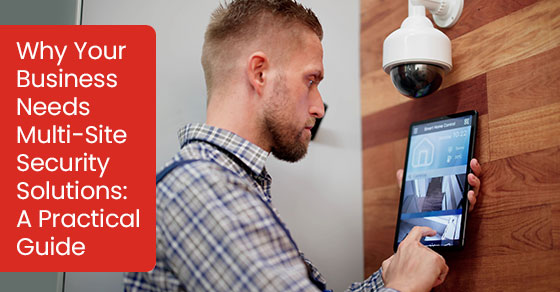
Through a smart business security app or cloud-based platform, authorized users can arm or disarm systems, check site status, review activity, and receive notifications. For owners responsible for several commercial properties, mobile control reduces unnecessary site visits and helps resolve issues before they become next-day problems.
Staff, contractors, cleaners, and managers often need different levels of access at different locations, and those permissions can change frequently as schedules, roles, and vendor relationships shift. Without centralized controls, access management can become inconsistent from one property to the next.
| Access Challenge | Risk With Shared or Separate Codes | Benefit of Centralized User Controls |
|---|---|---|
| Accountability | Shared codes make it difficult to confirm who entered, exited, or accessed a restricted area. | Unique credentials connect access activity to specific users, locations, and times. |
| Staff and vendor changes | Former employees, contractors, or temporary vendors may retain access if codes are not updated everywhere. | Permissions can be changed, limited, or removed quickly across locations. |
| Multi-location consistency | Each site may follow different access procedures, creating uneven security habits. | Standardized access rules support clearer oversight across locations, departments, and schedules. |
| Incident review | Incomplete or inconsistent records can slow down investigations after unusual activity. | Managers can review access history more easily when checking alerts, incidents, or after-hours events. |
After an alarm, access event, or late closing, user-specific records give managers a better starting point for follow-up. Access can also be adjusted or removed quickly when roles change, contracts end, or staff leave the business.
Alarm notifications do not always explain what is happening at a property. Video monitoring adds visual context for deliveries, customer-facing areas, after-hours activity, and restricted spaces without relying only on verbal updates or written reports.
After an alarm, delivery issue, access event, or suspicious activity report, connected cameras make relevant footage easier to review without pulling it from a separate local system.
Alerts only matter if they reach the right people. If one location loses internet, phone service, or power, managers need confidence that critical alerts will still get through where backup options are available.
Cellular backup communication, encrypted wireless devices, backup power support, and professional monitoring infrastructure can reduce the risk of missed alerts during outages, service interruptions, or attempted tampering. For a multi-location business, one weak connection should not become a hidden security gap.
New locations create security work before they even open. Staff need permissions, cameras need to suit the layout, and each site needs to connect to familiar reporting and monitoring routines.
A scalable setup brings new locations, cameras, sensors, users, and access points into the existing security structure. Growing businesses avoid a patchwork of separate logins, inconsistent permissions, and one-off routines that become harder to manage over time.
A single alarm log does not show whether the same location keeps missing closing procedures or the same access issue is happening after hours. Consolidated reporting gives managers a clearer way to compare activity across locations instead of reviewing each site in isolation.
Once a pattern is visible, the next step is operational follow-up. Managers can address the source of the issue instead of treating every incident as a one-off event.
If a closing team repeatedly misses an arming step or a vendor code appears outside approved hours, the business can correct the procedure, limit the access, and reduce the chance of the same problem continuing across future shifts.
Multi-site business security systems are most useful when they reduce fragmented oversight. Owners and managers need a practical way to check activity, update access, review video, and respond to alerts without waiting on separate reports or site-by-site updates.
At Canadian Security Professionals, our commercial security setups help businesses manage alerts, access, video, and user activity across connected locations. For growing businesses, professionally monitored business security systems can reduce the confusion that comes from separate tools, inconsistent permissions, and disconnected site information.
Reach out to Canadian Security Professionals today at 1-877-494-9911, email us at info@cspalarms.ca, or click here to get in touch online.
A multi-site system allows businesses to monitor and manage security across several commercial locations through one centralized platform.
Centralized monitoring, reporting, and access management reduce the need to check separate systems at each location. Managers can compare activity, respond to alerts, and update permissions from a more consistent security setup.
Yes. Most modern systems can support additional locations, users, cameras, and access points as business needs change.
Many commercial security systems offer remote monitoring through mobile apps or cloud-based platforms, so authorized users can check site status, receive alerts, and respond to after-hours issues without being on the property.
Professional monitoring adds response support when alarms are triggered, especially when owners or managers cannot be present at every property.

 Hours of Operation:
Monday to Thursday: 8:00 AM to 9:00 PM
Friday: 8:00 AM to 7:00 PM
Saturday: 11:00 AM to 4:00 PM (EST)
Press option 1 to reach our 24/7 Monitoring Centres




Fill out the form and a CSP security specialist will contact you about our current offers.
Call now to learn more
about our current offers.

Call Now
1-877-494-9911
Security Specialists Available: Monday to Thursday: 8:00 AM to 9:00 PM | Friday: 8:00 AM to 7:00 PM | Saturday: 11:00 AM to 4:00 PM (EST)